Water Treatment & Conditioning
Reverse Osmosis System
Using semi-permeable membrane technology, reverse osmosis systems separate minerals, bacteria and heavy metals from water, purifying steam boiler and steam generator feedwater.
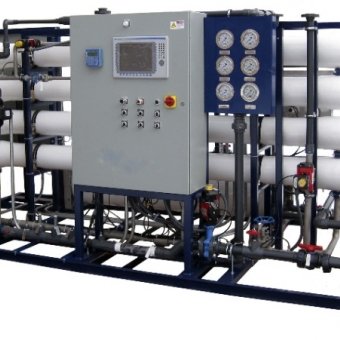
What Is a Reverse Osmosis Treatment System?
Reverse osmosis is the phenomenon by which a semi-permeable membrane between two solutions of different ion concentration equalizes those concentrations via osmotic pressure. To reverse this phenomenon, a pump applies a pressure greater than the osmotic pressure; the semi-permeable membrane, containing pores around 5 angstroms in size, then passes only pure water while retaining bacteria, pathogens, organic matter and heavy metals, purifying the water to a certain degree.
Reverse osmosis is the membrane filtration process applied to waters where classic treatment systems fall short, separating out all unwanted minerals to obtain pure water. The reverse osmosis system's operating principle relies on the membranes in the unit: water is forced through the pores on the membrane under high pressure. During this process, water molecules and some inorganic molecules can pass through the pores, while most of the substances in the water cannot, and are discharged as concentrate.
Reverse Osmosis Operating Principle
First, raw water is freed of sediment, chlorine and limescale that could damage the membranes, using a sand filter and a water softener. Softened and cleaned water, pressurized to at least 2-3 bar, enters the reverse osmosis system. There, a final filtration to 5-micron precision is carried out with cartridge water filters, and antiscalant chemical is added to the water; dosing is carried out with automatic pumps. The treated water is then raised by a high-pressure pump to the pressure specified in the project design and pumped to the membranes. The membrane creates a physical resistance to the hydraulic pressure, and only water molecules can pass through it. The ions on the concentrate side, along with a certain amount of water, are continuously discharged to the waste-water channel.
Recommended Inlet Water Characteristics for Reverse Osmosis
- Inlet water TDS: 0 - 2,000 ppm
- Operating pressure: 10-15 bar
- Inlet water pressure: 2-5 bar
- ASC dosing required if hardness exceeds 3 French degrees
- pH range: 6 - 8
- Silica (SiO2) tolerance: 25 ppm max. (at 60% efficiency)
- Max. inlet water temperature: 30°C
- Max. iron (Fe) tolerance: 0.05 ppm (0.2 ppm if ASC is dosed)
- No hydrogen sulfide
- No turbidity (NTU < 1)
- No oil or grease
- SDI < 5
- No microbiological contamination
Degree of Purification by Substance Type
- Univalent (monovalent) ions: 90%
- Polyvalent ions: 95%
- Bacteria: 99%
- Organic matter: 99%
- Pyrogens: 99%
Steam Boiler Feedwater Preparation
Especially in facilities using open steam, condensate return to the steam boiler is low. In such systems, the boiler is continuously supplied with fresh feedwater; as a result, boiler water conductivity rises quickly, and boiler blowdown is increased to reduce conductivity. Because boiling water is discharged to drain during bottom and surface blowdown, heat energy is lost; increased blowdown also increases fuel consumption. Feeding the steam boiler with low-conductivity water prepared by a reverse osmosis unit, instead of high-conductivity water, reduces boiler blowdown and delivers fuel savings.
Steam Generator Feedwater Preparation
Because a steam generator's water volume is small, the incoming water changes state to steam in a short time, and the minerals in the water solidify inside the generator's tubes. Feeding the steam generator with softened water does not fully prevent this scaling, because softened water only replaces the calcium and magnesium molecules in the feedwater with sodium, while still containing a large amount of minerals. These scale-forming minerals quickly reduce the generator's heat efficiency. For this reason, it is recommended that the steam generator be fed with water produced and purified by reverse osmosis.

Heaton® Reverse Osmosis System is manufactured by İtimat Kazan.